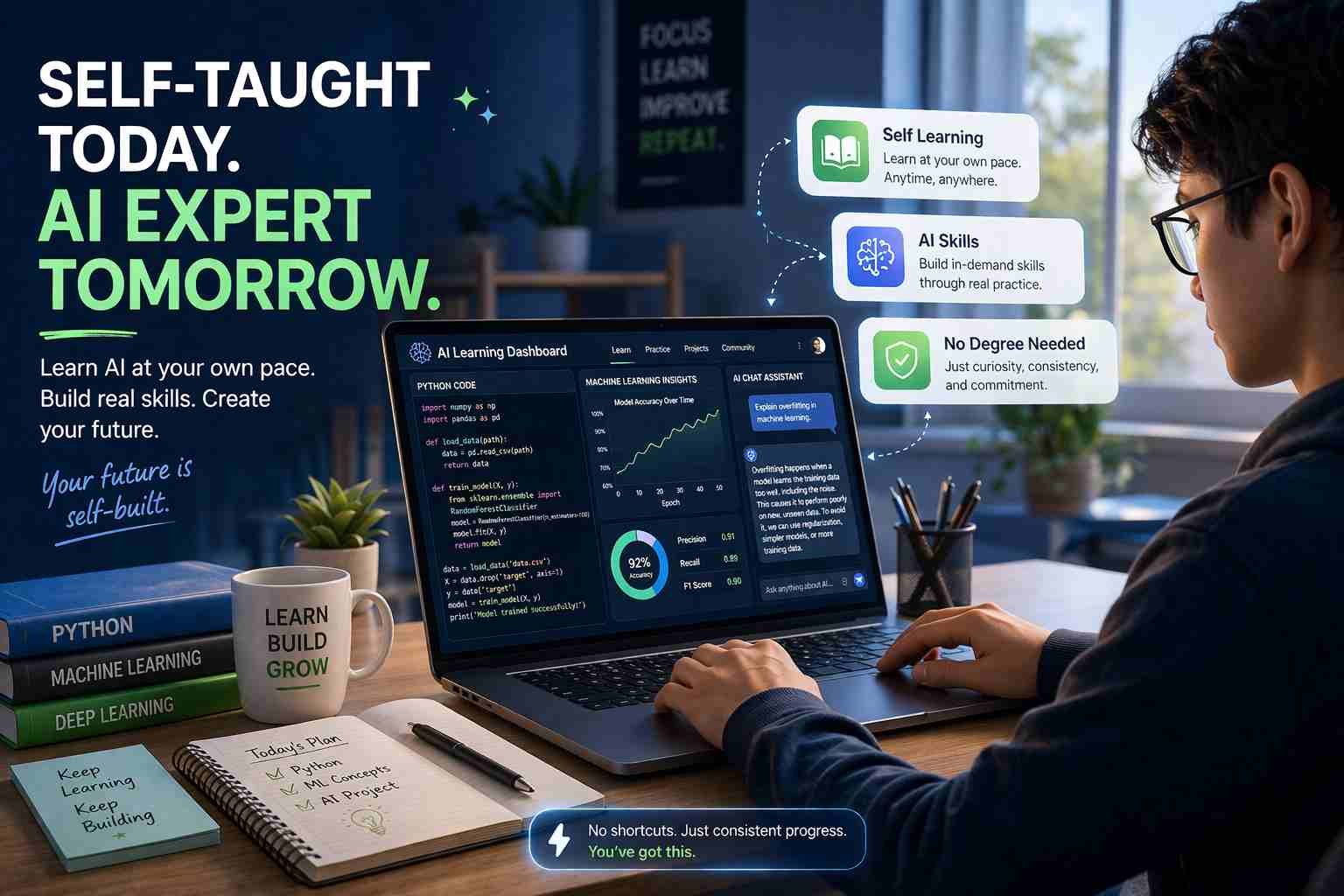
 You don’t need a degree to become an AI specialist. That’s the honest answer. What you do need is skills, proof of work, and a bit of patience. Companies today care more about what you can build than what certificate you hold.
Let me explain it in a simple way. If you can create a working AI project, understand how models behave, and solve real problems, you already stand ahead of many degree holders who only studied theory. That’s where things have shifted.
Now let’s walk through what actually matters.
Understanding if you really need a degree for AI
Short answer: no, you don’t.
Long answer: a degree helps, but it’s not required anymore. Many companies like Google, Tesla, and even startups openly hire people based on skills, not formal education. The AI field is moving fast, and practical ability is more valuable than academic background.
Here’s what changed. Before, degrees were the only way to prove knowledge. Now your GitHub profile, projects, and real-world work do that job better.
If you can show results, nobody cares where you studied.
So what does an AI specialist actually do
People hear “AI specialist” and imagine something very complex. But it’s easier to understand when you break it down.
An AI specialist usually does one of these things:
- Builds models that learn from data
- Creates tools like chatbots, recommendation systems, or automation scripts
- Works with data to find patterns and predictions
Some common roles include:
- Machine Learning Engineer
- AI Developer
- Data Analyst with AI tools
At the core, it’s about teaching machines to solve problems. That’s it.
The skills that actually matter more than a degree
Here’s where you should focus. Not everything, just the right things.
First is Python. Almost every AI tool and model uses it. You don’t need to master it fully, just enough to build projects.
Then comes machine learning basics. Understand how models learn, what training data is, and how predictions work.
You also need data handling skills. AI runs on data. If you can clean and organize data, you’re already valuable.
And now, something new: prompt engineering. Tools like ChatGPT changed the game. Knowing how to guide AI properly is a real skill.
Bottom line: skills beat degrees. Every time.
Where most beginners go wrong
This part matters more than you think.
Most people spend months watching courses and still feel stuck. Why? Because they never build anything.
Here’s the common pattern:
They watch tutorials
They take notes
They feel productive
But they never apply
And then they quit.
Another mistake is fear of coding. People think AI means heavy math and complex coding. In reality, tools today make things much easier.
The difference between success and failure is simple: building vs watching.
A simple roadmap you can actually follow
Let’s keep this real and practical.
Start with basic Python. Don’t overthink it. Just learn enough to write simple scripts.
Then move to machine learning basics. Learn how models work in simple terms.
After that, build small projects. For example, a chatbot, a simple prediction tool, or even an AI content generator.
Once you have 2 to 3 projects, put them on GitHub.
Then start applying. Freelance platforms, internships, or even small remote jobs.
You don’t need to wait until you feel ready. You won’t.
Tools and platforms that can teach you faster
You don’t need expensive courses.
Some of the best tools are already free or low-cost:
- ChatGPT for learning and coding help
- Kaggle for datasets and practice
- YouTube for tutorials
- Coursera for structured learning
- GitHub for sharing your work
What’s interesting is that AI tools themselves help you learn AI. That’s something that didn’t exist a few years ago.
Can you really get an AI job without a degree
Yes, and it’s already happening.
Companies are shifting toward skill-based hiring. They care about:
- What you can build
- How you solve problems
- How you think
Not your degree.
Freelancing is even easier. Clients only care about results.
If your project works, you get paid. Simple.
The truth about the $900,000 AI job
You’ve probably heard this number. It’s real, but there’s context.
Top AI roles like AI researchers or senior machine learning engineers at big companies can earn very high salaries. Sometimes close to that number.
But those roles require years of experience and deep expertise.
For beginners, a more realistic starting point is much lower. And that’s fine.
The important thing is growth. AI is one of the fastest-growing fields, and salaries increase quickly with experience.
What is the 30 percent rule in AI learning
This is something many beginners ignore.
The idea is simple:
Spend about 30 percent of your time learning theory
Spend 70 percent building and practicing
Most people do the opposite, and that’s why they struggle.
AI is not something you learn by reading. You learn it by doing.
Which jobs will survive AI and why this matters
This question is everywhere right now.
The truth is, AI will replace repetitive tasks. But it will not replace people who can use AI.
Three types of jobs are safer:
People who build AI
People who think creatively
People who solve complex problems
If you become an AI specialist, you are not competing with AI. You are working with it.
How to build your first AI portfolio
You don’t need something big. Start small.
Build a chatbot using AI APIs
Create a simple recommendation system
Try an image recognition project
What matters is not perfection. It’s proof.
Put everything on GitHub. Write simple explanations of what you built.
That becomes your real resume.
What I would do if I started today
I’d keep it simple.
Learn basic Python for a few weeks
Use ChatGPT to understand concepts faster
Build one small project immediately
Then build another
No waiting. No overthinking.
Within a few months, you’ll see progress.
The part most people ignore but shouldn’t
Consistency.
This is where most people fail. Not because they are not smart, but because they stop.
AI looks complex at first. It feels confusing. But if you keep going, it starts making sense.
Even one hour a day is enough.
Stay consistent, build projects, and keep learning.
That’s how you become an AI specialist without a degree.

Alexandra Smith: All things tech, News, Social Media Guide, and gaming expert. Bringing you the latest insights and updates on Mobiledady.com