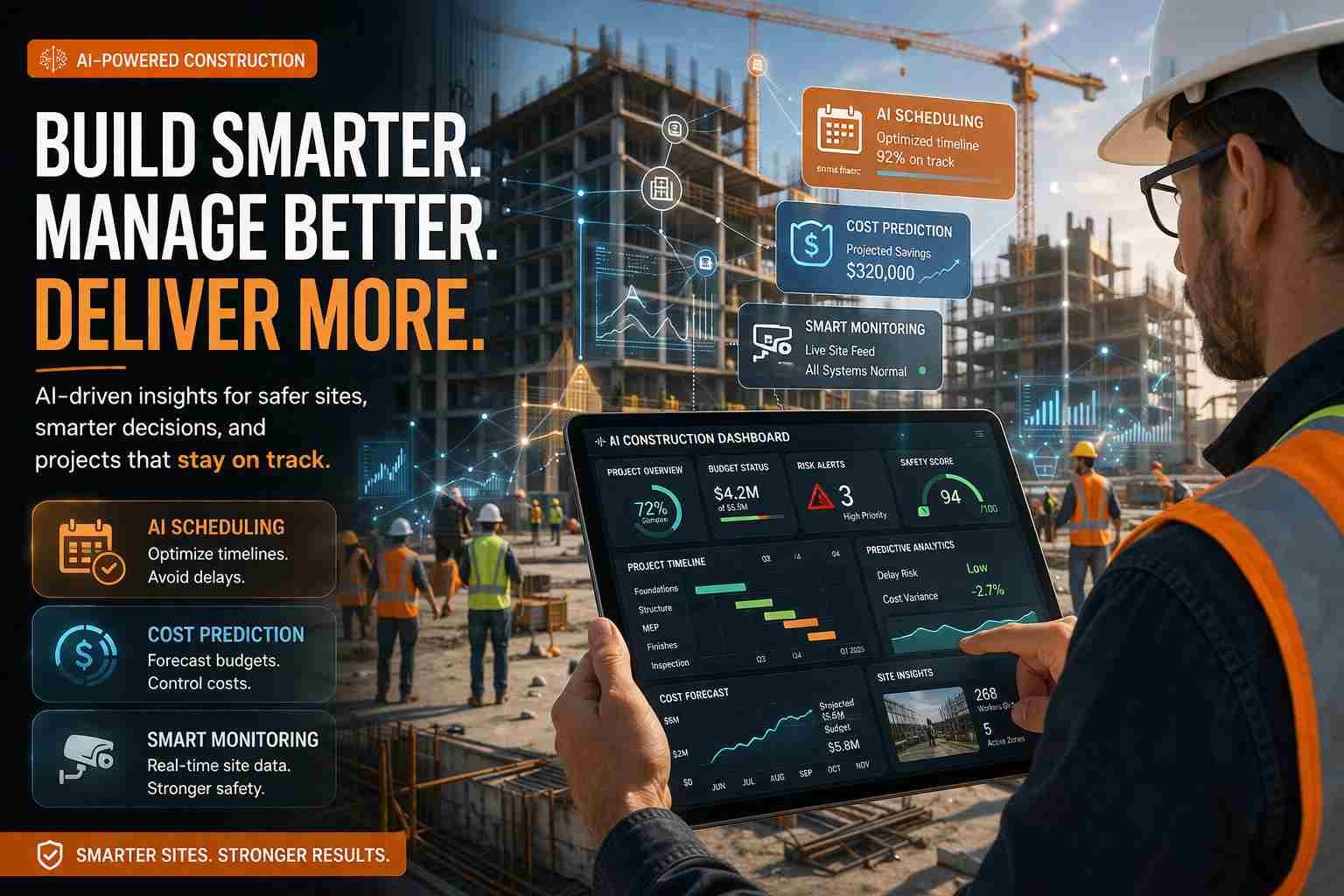
 If you’re wondering how to use AI in construction project management, here’s the simple answer: start small, focus on one problem like delays or cost tracking, and use AI tools to predict, monitor, and automate those tasks. You don’t need a huge budget or technical skills to begin. Most modern tools already have AI built in. You just need to use them the right way.
Let me explain how this actually works in real construction environments, not just in theory.
What does AI actually mean in construction projects
AI in construction is not robots building your site overnight. It’s more practical than that.
It’s software that studies data from your project and helps you make better decisions. That includes things like predicting delays, tracking costs, identifying risks, and improving scheduling.
For example, instead of guessing how long a task will take, AI looks at past projects and gives a more accurate timeline. Instead of manually checking progress, AI can analyze site photos and tell you what’s done and what’s behind.
So really, AI is like having a smart assistant that watches your entire project and keeps pointing out what needs attention.
Why construction companies are slowly moving toward AI
Construction has always struggled with a few big problems.
Projects get delayed. Budgets go out of control. Communication breaks. Safety risks increase.
Here’s where AI changes things.
AI doesn’t get tired or miss patterns. It continuously analyzes data and highlights problems early. That means you can fix issues before they become expensive mistakes.
For example:
- AI can warn you that a delay is likely before it actually happens
- It can detect unsafe behavior on site through cameras
- It can estimate costs more accurately based on real data
This is why even traditional construction companies are now investing in AI tools.
Where AI fits into a real construction project
AI is not just for one part of the project. It fits almost everywhere.
During planning, AI helps create realistic schedules and cost estimates.
During design, it can suggest better layouts and detect clashes in building models.
During execution, it tracks progress and predicts delays.
During monitoring, it analyzes site data and keeps everything aligned.
Think of it like this. AI connects all parts of the project and makes sure nothing is ignored.
How to use AI in construction project management in real life
Here’s what actually works in the field.
Start with your biggest problem. Maybe your projects are always delayed. Or maybe costs go out of control.
Now pick an AI tool that solves that one issue.
For example, if scheduling is your problem, use a tool that predicts delays and adjusts timelines automatically. If cost tracking is your issue, use AI-based estimation tools.
You don’t need to change everything at once. Just integrate AI into your existing workflow.
Let’s say you’re already using project management software. Many of these tools now include AI features like smart alerts, predictive analytics, and automated reports.
So instead of replacing your system, you upgrade it with AI.
That’s the practical way to use AI without getting overwhelmed.
AI tools for construction project management that actually work
There are many tools out there, but a few stand out because they are already being used in real projects.
Autodesk Construction Cloud
Helps with design, planning, and collaboration. AI helps detect design issues and improve coordination.
Procore
A popular platform for managing construction projects. It uses AI for data insights, reporting, and risk detection.
Buildots
Uses cameras and AI to track site progress automatically. It compares actual progress with planned schedules.
ALICE Technologies
Focuses on scheduling. It runs multiple simulations to find the best possible construction plan.
Each of these tools solves a specific problem. That’s why it’s better to choose based on your needs instead of trying everything.
The part most people miss about AI in construction
Here’s the truth.
AI is only as good as the data you give it.
If your project data is messy, incomplete, or inaccurate, AI will give poor results. This is where many people get disappointed.
Also, AI is not a replacement for human judgment. It supports decisions, but you still need experience to make the final call.
So the real secret is this:
Clean data + human oversight = best AI results
Can small contractors or beginners use AI
Yes, and honestly, this is where things are changing fast.
You don’t need to be a big company anymore.
Many tools now offer simple dashboards, mobile apps, and affordable plans. Even small contractors can use AI for things like:
- Budget tracking
- Task scheduling
- Site reporting
In fact, small teams often benefit more because they don’t have complex systems to change.
Start simple, and grow from there.
Real examples of AI being used on construction sites
Let’s make this real.
A construction company used AI cameras to track worker movement and detect safety risks. Accidents reduced significantly because alerts were generated in real time.
Another company used AI scheduling tools to simulate different project timelines. They found a faster way to complete the project and saved weeks of work.
Some teams use AI dashboards that combine weather data, labor availability, and supply chain updates. This helps them adjust plans instantly.
These are not future ideas. They are already happening.
Common mistakes people make when using AI in construction
This is where things go wrong for many people.
They expect AI to solve everything instantly.
They use too many tools at once.
They don’t train their team properly.
They ignore data quality.
The smarter approach is simple.
Pick one tool. Solve one problem. Learn from it. Then expand.
Is there any PDF or learning resource worth checking
You’ll find many PDFs about how to use AI in construction project management, but most of them are theoretical.
They explain concepts, not real usage.
What actually helps is hands-on experience. Try demos of tools like Procore or Autodesk. Watch real project case studies. Use trial versions.
That’s where you learn faster.
What the future of AI in construction project management looks like
AI is moving toward full automation, but not in the way people think.
We’ll see smarter scheduling, real-time decision systems, and deeper integration with robotics and IoT devices.
Imagine a system that not only predicts delays but automatically adjusts your entire project plan.
That’s where things are heading.
So how should you actually start using AI today
Don’t overthink it.
Look at your current project and ask one simple question.
Where do we lose the most time or money?
That’s your starting point.
Find a tool that solves that specific issue. Use it. Test it. Learn from it.
Once you see results, everything else becomes easier.
That’s how AI fits into construction. Not as a big change, but as a smart upgrade to how you already work.

Alexandra Smith: All things tech, News, Social Media Guide, and gaming expert. Bringing you the latest insights and updates on Mobiledady.com