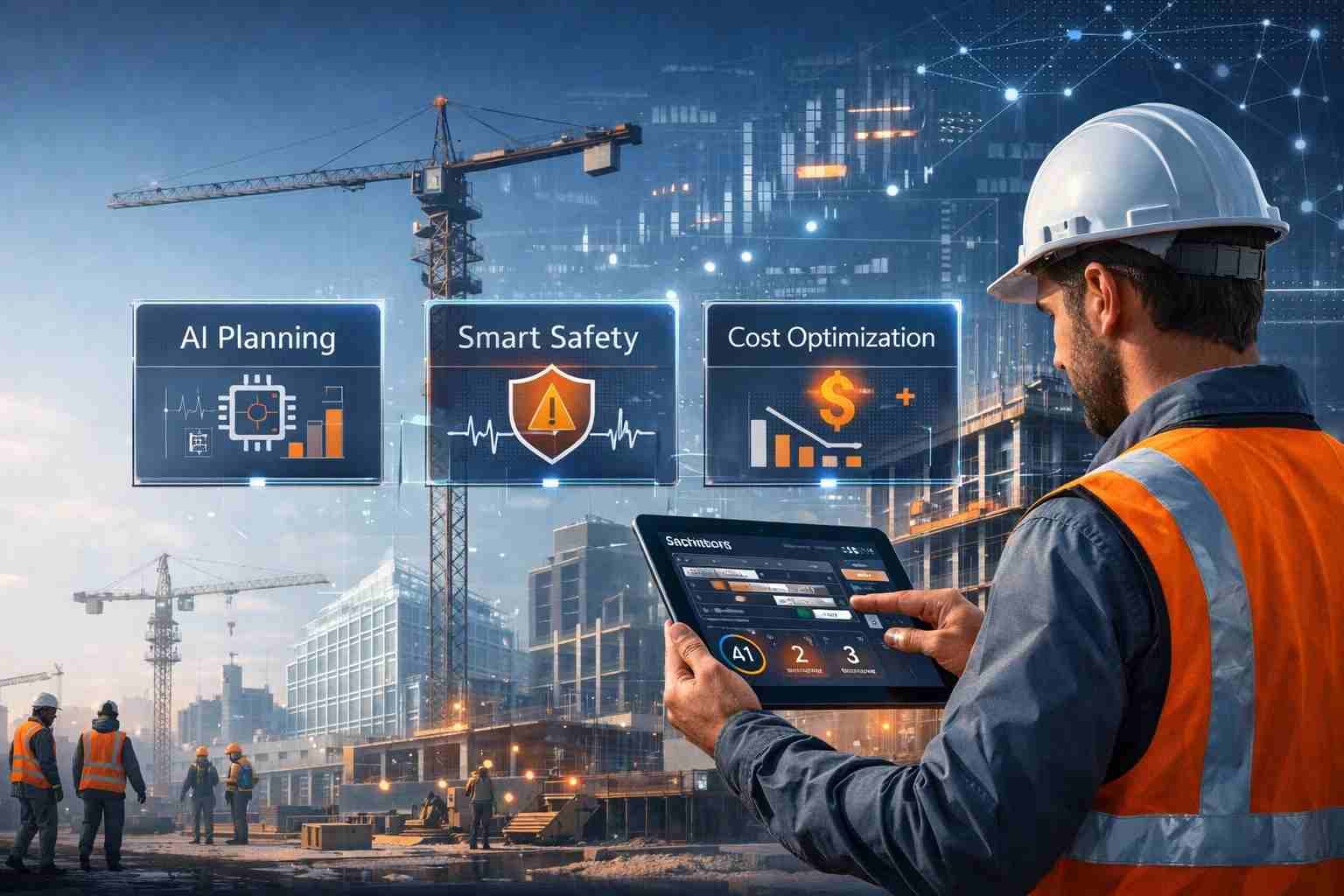
 Right now, AI is already changing construction. Not in a dramatic “robots replacing everyone overnight” way, but in a quieter, practical way. It’s making planning faster, reducing mistakes, improving safety, and slowly changing how work gets done on-site.
If you’re in construction or thinking about it, here’s the simple truth: AI won’t replace the entire industry, but it will reshape how people work inside it.
Let me walk you through what’s actually happening.
How AI is already changing construction today
AI is not a future idea anymore. It’s already being used on real construction sites.
The biggest shift is in planning and decision-making. Tools like Building Information Modeling (BIM), AI scheduling software, and predictive analytics are helping companies avoid costly mistakes before work even starts.
For example, instead of guessing how long a project might take, AI can analyze past projects and give a much more accurate timeline. That alone saves money and reduces delays.
You’ll also see AI working quietly in the background through:
- Drones scanning sites and creating 3D maps
- Cameras detecting safety risks in real time
- Software predicting material shortages
- Smart machines assisting with repetitive work
So the change has already started. It’s just not always obvious unless you’re inside the system.
What actually happens when AI enters a construction site
When AI comes into a construction workflow, four things change almost immediately.
First, planning becomes smarter. Instead of manual estimates, AI gives based predictions. That means fewer surprises.
Second, mistakes drop. AI can detect design clashes or structural issues early. That prevents expensive rework.
Third, safety improves. AI systems can monitor workers, equipment, and risky zones. Some systems even alert managers before accidents happen.
Fourth, cost control gets tighter. AI tracks budgets in real time and flags overspending early.
Here’s the interesting part. AI doesn’t replace the site. It supports it. It acts more like a second brain than a replacement worker.
The part most people worry about which jobs are at risk
Let’s be honest. This is what most people want to know.
Yes, some roles will change or shrink. But it’s not as extreme as people think.
Jobs that are most at risk are usually:
- Repetitive manual labor tasks
- Basic data entry or documentation roles
- Low-skill supervision tasks
For example, if a job is mainly about repeating the same action again and again, AI or machines can handle it faster and more accurately.
But here’s the key point: construction is still a physical, unpredictable environment. That makes full automation difficult.
So instead of jobs disappearing completely, many roles will evolve.
Which 3 jobs will survive AI in construction
Some roles are actually becoming more valuable because of AI, not less.
Let me break it down simply.
Skilled trades
Electricians, plumbers, welders. These jobs require hands-on skill, judgment, and problem-solving in real conditions. AI can assist, but not replace them.
Project managers
AI can give data, but someone still has to make decisions, manage people, and handle unexpected situations. That human layer stays critical.
Tech-aware operators
This is the new category. People who understand how to use AI tools, machines, and digital systems will be in high demand.
So if you’re thinking long-term, the safest path is not avoiding AI. It’s learning how to work with it.
The 30 percent rule for AI what it really means
You might have heard this idea that AI will take over 30% of jobs. That’s not quite accurate.
What it actually means is this:
AI can automate around 30% of tasks within a job, not the entire job itself.
Let me give you a simple example.
A site engineer doesn’t just do one thing. They:
- Plan tasks
- Manage workers
- Check designs
- Monitor progress
- Solve problems
AI might automate scheduling and reporting. That’s maybe 30% of the workload.
But the rest still needs human thinking.
So instead of replacing the engineer, AI makes them more efficient.
Which parts of construction will benefit the most
Some areas are seeing massive improvements already.
Safety management
AI cameras and sensors can detect risks instantly. That means fewer accidents and better compliance.
Cost estimation
AI can analyze past data and give accurate budgets. This reduces financial surprises.
Project timelines
Delays are common in construction. AI helps predict and avoid them.
Risk detection
From weather impacts to supply chain issues, AI can warn teams early.
These are not small upgrades. They directly affect profits, deadlines, and worker safety.
Which industry is most affected by AI and where construction stands
If you compare industries, construction is not the most affected.
Industries like:
- Manufacturing
- Finance
- Customer service
have seen faster automation because their work is more digital and repetitive.
Construction is different. It’s physical, complex, and constantly changing.
That’s why it’s being affected more slowly, but steadily.
And here’s the catch. Because it’s slower, many companies are still behind. That creates a huge opportunity for those who adapt early.
What this means for workers right now
This is where things get practical.
If you’re working in construction today, you don’t need to panic. But you also shouldn’t ignore what’s happening.
What actually helps is simple:
- Learn basic digital tools used in construction
- Get familiar with AI-based planning software
- Understand how smart equipment works
- Stay open to new ways of working
You don’t need to become a programmer. You just need to stay adaptable.
The people who struggle the most are usually the ones who refuse to change.
Where things are heading in the next few years
Construction is moving toward something more connected and intelligent.
You’ll start seeing:
- Semi-automated construction machines
- AI-driven project management systems
- Real-time site monitoring through sensors
- Integration with smart city systems
But fully automated construction sites? That’s still far away.
The environment is too unpredictable for full automation right now.
So the future is not “AI replacing workers.”
It’s AI working alongside workers.
So what should you actually do if you’re in construction
Here’s the honest takeaway.
AI is not coming to take your job overnight. But it is coming to change how your job works.
The smart move is simple.
Don’t fight it. Learn it.
Even small steps matter. Understanding how AI tools work, how data is used, how planning is changing. That alone can put you ahead of most people.
Because in the end, construction will still need people.
Just not the same kind of people it needed before.

Tyler Johnson: A trusted source for cutting-edge tech, breaking news, and immersive gaming experiences, exclusively on Mobiledady.com.