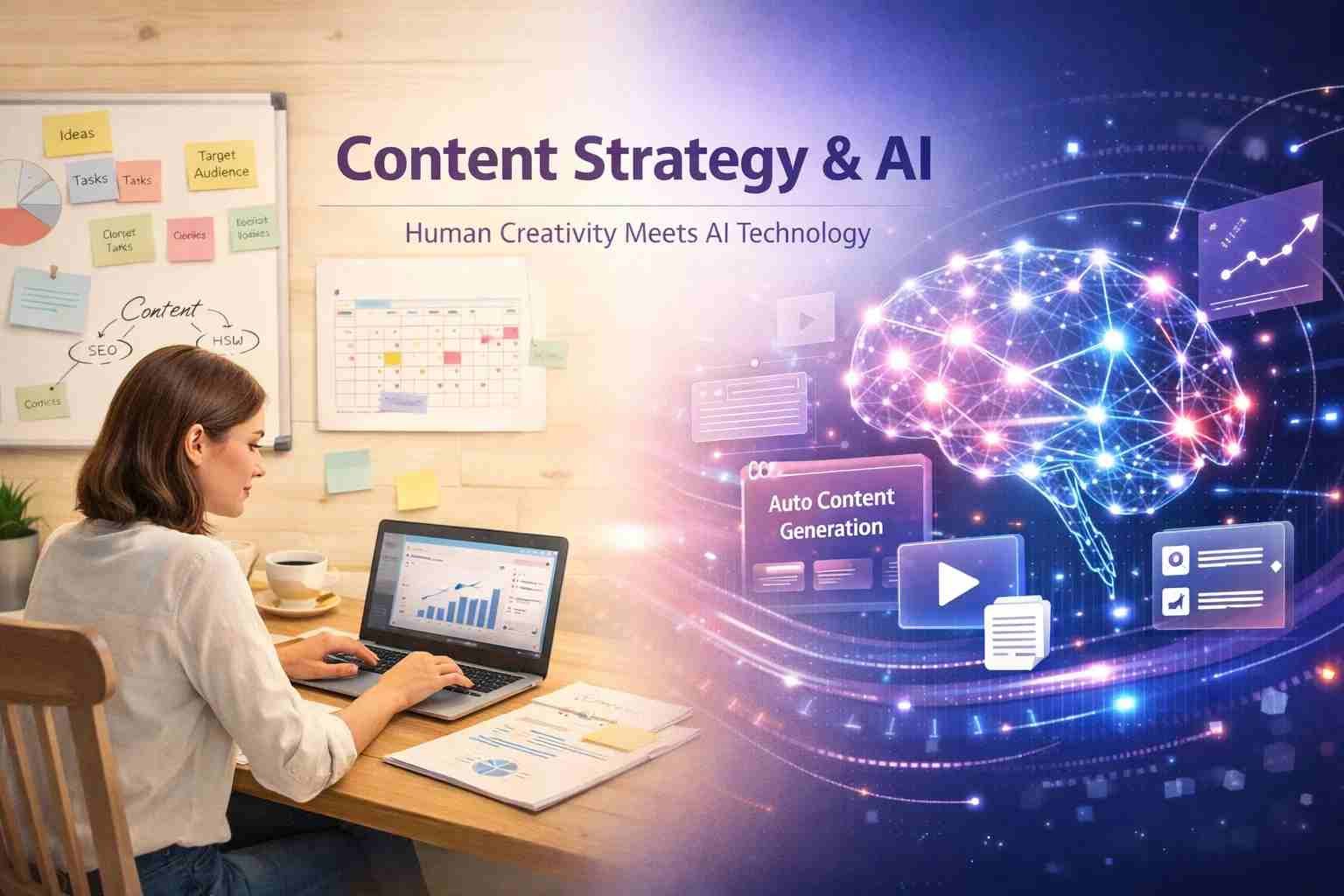
 Let’s get straight to it.
No, AI will not replace content strategy. But it is changing it faster than most people expected.
If you’re thinking AI can plan, think, and understand your audience like a human strategist, that’s not how it works. What AI does really well is speed things up, analyze patterns, and generate ideas. What it still struggles with is judgment, emotion, and real-world context.
So the real story isn’t replacement. It’s transformation.
What people really mean when they ask if AI will replace content strategy
Most people asking this question are actually worried about two things:
Will AI take my job?
And do I even need to learn strategy anymore?
Here’s the thing. Content strategy is not just writing or posting content. It’s about understanding why something should be created, who it’s for, and what result it should drive.
AI can generate content.
But strategy is about direction. And direction still needs a human brain.
What AI content strategy actually is in simple terms
AI content strategy means using artificial intelligence tools to help plan, create, and optimize content more efficiently.
It doesn’t replace thinking. It supports it.
For example:
Instead of manually researching keywords for hours, tools like ChatGPT or Surfer SEO can suggest topics, analyze trends, and even predict what might perform well.
A simple workflow looks like this:
- You define the goal
- AI helps with research and ideas
- You refine the message
- AI assists in drafting
- You optimize and publish
So AI becomes your assistant, not your replacement.
The part most people misunderstand about AI replacing strategy
Here’s where things get messy.
People see AI writing blogs, scripts, and captions and assume it understands the content. But it doesn’t. It predicts words based on patterns.
That means:
- It doesn’t truly understand your audience
- It doesn’t feel emotions
- It doesn’t know your business goals unless you tell it
Let me explain it simply.
AI is like a very fast student who memorized everything on the internet.
A strategist is someone who knows what actually matters.
That difference is huge.
How content strategy is already changing because of AI
Now here’s where AI is making a real impact.
Content teams are moving faster. Way faster.
Things that used to take days now take hours:
- Keyword research
- Topic generation
- Draft creation
- SEO optimization
Tools like ChatGPT, Jasper, Copy.ai, and Notion AI are becoming part of everyday workflows.
But the biggest shift is this:
Strategy is becoming more about decision-making and less about manual work.
People who adapt are not writing less. They’re thinking more.
The core pillars of AI strategy that actually matter
If you strip everything down, AI strategy works on a few key pillars.
Data
AI depends on data. The better your data, the better your results.
Automation
Repetitive tasks like formatting, tagging, or scheduling are handled by AI.
Personalization
AI helps tailor content for different audiences at scale.
Decision intelligence
AI gives insights, but humans decide what to do with them.
Human oversight
This is the most important part. Without human input, AI content becomes generic fast.
These pillars show one thing clearly. AI is powerful, but it needs guidance.
The different types of AI you should know before using it
You don’t need to be technical, but understanding basic AI types helps a lot.
Narrow AI
This is what we use today. It does specific tasks like writing, analyzing, or recommending.
Generative AI
Tools like ChatGPT that create content, images, or ideas.
Predictive AI
Used in analytics to forecast trends or user behavior.
Reactive vs learning AI
Reactive AI responds to input. Learning AI improves over time with data.
Most content tools you use today are a mix of generative and predictive AI.
The 7 C’s of AI and why they matter in content planning
Instead of thinking in technical terms, it helps to break AI into simple principles.
Here’s a practical version of the 7 C’s:
Content – What you create
Context – Why it matters
Customer – Who it’s for
Consistency – How often you show up
Clarity – How easy it is to understand
Creativity – What makes it stand out
Conversion – What action it drives
AI can help with all of these, but it cannot own them. You still control the direction.
What still needs human thinking no matter how advanced AI gets
This is the part people underestimate.
Even the best AI cannot fully replace:
- Real creativity
- Emotional storytelling
- Cultural understanding
- Brand voice
- Ethical judgment
AI can suggest ideas.
But it doesn’t know what your audience feels.
That’s why human input still shapes great content.
Which jobs will survive AI and why strategy is one of them
Short answer: jobs that involve thinking, decision-making, and human connection will survive.
Content strategists fall right into that category.
What may disappear:
- Basic content writing roles
- Repetitive SEO tasks
- Simple copy generation
What will grow:
- Strategy roles
- Content planners
- Brand storytellers
- AI-assisted marketers
So the job doesn’t disappear. It evolves.
The best AI tools people are using for content strategy today
Here are some tools actually being used right now:
ChatGPT
Idea generation, drafting, research support
Jasper AI
Marketing-focused content writing
Copy.ai
Quick social media and ad copy
Surfer SEO
Content optimization based on ranking data
Notion AI
Planning, documentation, workflow support
Each tool solves a different part of the strategy process.
The simple rule smart marketers are following right now
A lot of people are quietly following a hybrid rule.
You can think of it like this:
- 30% human thinking
- 30% AI assistance
- 30% testing and optimization
And the remaining 10% is instinct. That gut feeling you build with experience.
This balance is what separates average content from great content.
What a modern AI-powered content workflow actually looks like
A typical workflow today looks something like this:
You start with a goal. Maybe traffic, leads, or engagement.
Then AI helps you:
- Find trending topics
- Analyze keywords
- Generate draft ideas
After that, you step in:
- Refine the message
- Adjust tone
- Align with brand
Then AI helps again:
- Optimize for SEO
- Suggest improvements
And finally, you publish and track performance.
It’s not AI vs human. It’s a loop.
So will AI replace content strategy or not
No. It won’t.
But it will replace outdated ways of doing strategy.
People who rely only on manual work will struggle.
People who combine thinking with AI will move ahead.
That’s the real shift happening.
What I’d focus on if I was starting content strategy today
Honestly, I wouldn’t focus only on writing.
I’d focus on:
- Understanding audiences
- Learning AI tools
- Studying content performance
- Practicing decision-making
Because tools change fast.
But thinking skills stay valuable.
Where this is all heading in the next few years
We’re moving into a world where search itself is changing.
AI answers, voice assistants, and generative search engines are becoming the norm.
Content won’t just rank. It will be selected by AI systems.
That means:
- Clear answers matter more
- Trust matters more
- Structure matters more
Strategy becomes even more important, not less.
A more honest way to think about AI and strategy going forward
Here’s the simplest way to look at it.
AI is not your competition.
It’s your tool.
The people who lose are not replaced by AI.
They are replaced by people who use AI better.
So instead of asking if AI will replace content strategy,
a better question is:
Are you ready to adapt your strategy with AI?
Because that’s where everything is heading.

Alexandra Smith: All things tech, News, Social Media Guide, and gaming expert. Bringing you the latest insights and updates on Mobiledady.com