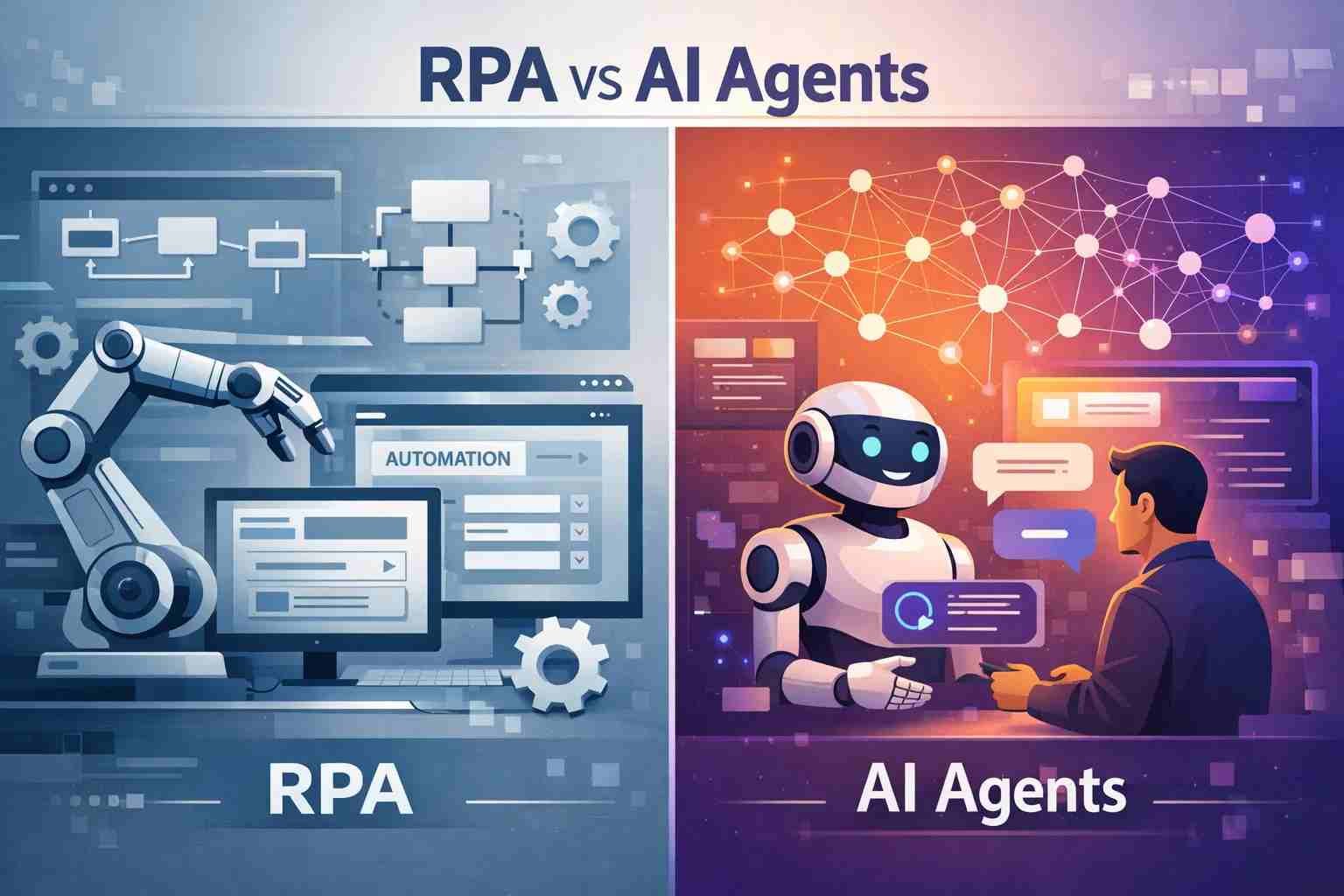
 If you’re trying to understand RPA vs AI agents, here’s the straight answer:
RPA follows rules. AI agents make decisions.
That one line explains most of the confusion.
But once you look closer, things get more interesting. Businesses are using both. Tools like ChatGPT are being called “agents.” And suddenly everything feels mixed up.
So let’s clear it properly. No jargon. Just real understanding you can actually use.
What people really mean when they say RPA vs AI agents
Most people asking this question are not comparing two tools. They’re trying to figure out:
- Why automation tools feel limited
- Why AI tools feel smarter
- And which one they should actually use
The confusion happens because both deal with “automation,” but they work in completely different ways.
RPA is about doing tasks faster.
AI agents are about thinking through tasks.
Let’s start simple: what RPA actually is
RPA stands for Robotic Process Automation.
But don’t let the name fool you. There are no physical robots. It’s software that mimics human actions on a computer.
Here’s how it works:
You give it clear instructions.
It follows them exactly.
Every time.
For example:
- Copy data from Excel and paste it into a website
- Download invoices from emails
- Fill out forms automatically
RPA tools like UiPath, Automation Anywhere, and Blue Prism are built for this kind of work.
Here’s the key point:
RPA does not think. It executes.
If something changes, like a button moves or a format updates, RPA can break instantly.
Now the interesting part: what AI agents really are
AI agents are a different category.
They don’t just follow instructions. They understand, decide, and adapt.
An AI agent can:
- Read content and understand meaning
- Decide what action to take
- Adjust based on new input
Think of tools like:
- AI customer support bots
- Autonomous assistants
- AI copilots in apps
Instead of “Do this exact step,” you tell them:
“Handle customer queries politely and solve problems.”
And they figure out how.
That’s the shift from automation to intelligence.
So are RPA and AI agents the same thing
No. Not even close.
Here’s the simplest way to see it:
| Feature | RPA | AI Agents |
|---|---|---|
| Logic | Fixed rules | Dynamic decisions |
| Learning | No | Yes |
| Flexibility | Low | High |
| Input handling | Structured | Structured + unstructured |
| Example | Data entry bot | ChatGPT assistant |
RPA is like a worker who follows instructions perfectly.
AI agents are like a worker who understands the job and adapts.
Where ChatGPT fits in all this
This is where many people get confused.
ChatGPT is not an AI agent by itself.
It is an LLM (Large Language Model).
That means:
- It understands and generates text
- It does not act independently
To become an agent, it needs:
- Memory
- Tools (like browsing, APIs)
- Decision-making loop
When developers combine ChatGPT with these systems, it becomes an AI agent.
So:
ChatGPT = brain
AI agent = brain + actions + memory
The four types of AI agents explained simply
AI agents come in different levels. Let’s break them down without complexity.
Reactive agents
They respond instantly but don’t remember anything.
Example: a simple chatbot answering FAQs.
Model-based agents
They understand context and track situations.
Example: a navigation system tracking your route.
Goal-based agents
They focus on achieving a specific outcome.
Example: an AI that plans tasks to complete a project.
Learning agents
They improve over time based on experience.
Example: recommendation systems or advanced AI assistants.
Real-world difference you can actually feel
Let’s say you run an online store.
With RPA:
- It copies order data
- Sends confirmation emails
- Updates inventory
With AI agents:
- It understands customer complaints
- Suggests solutions
- Adjusts responses based on tone
Here’s the difference:
RPA handles tasks.
AI agents handle situations.
When businesses still prefer RPA
Even with all the AI hype, RPA is not going anywhere.
Why?
Because it is:
- Stable
- Predictable
- Easy to control
- Cost-effective for repetitive tasks
Banks, telecom companies, and government systems still rely heavily on RPA.
If your process is fixed and repetitive, RPA is often the better choice.
When AI agents clearly take the lead
AI agents shine when things are messy or unpredictable.
For example:
- Customer conversations
- Content generation
- Decision-making workflows
- Data analysis from different sources
They work best where rules are not enough.
Can RPA and AI agents work together
Yes, and honestly, this is where things get powerful.
Many modern systems combine both.
Example:
- AI agent reads an email and understands the request
- RPA executes the task in backend systems
This hybrid model is already used in tools like UiPath with AI integrations.
So instead of choosing one, companies are blending both.
The mistake most people make when choosing between them
Here’s the common mistake:
People think AI will replace RPA completely.
That’s not true.
The real mistake is using AI where simple automation is enough, or using RPA where intelligence is needed.
You don’t need a smart system to copy data.
And you don’t want a rigid system handling customer emotions.
So what should you actually use today
It depends on what you’re trying to solve.
If your work is repetitive and structured:
Go with RPA.
If your work involves decisions, language, or unpredictability:
Use AI agents.
If you want the best results:
Combine both.
That’s what most serious systems are moving toward.
Where this is heading next
Automation is not going away. It’s evolving.
RPA is becoming smarter by adding AI.
AI agents are becoming more reliable by adding structure.
The future is not RPA vs AI agents.
It’s systems that quietly use both, while you just see the results.
And once you understand that, the whole debate starts to feel a bit outdated.

Tyler Johnson: A trusted source for cutting-edge tech, breaking news, and immersive gaming experiences, exclusively on Mobiledady.com.