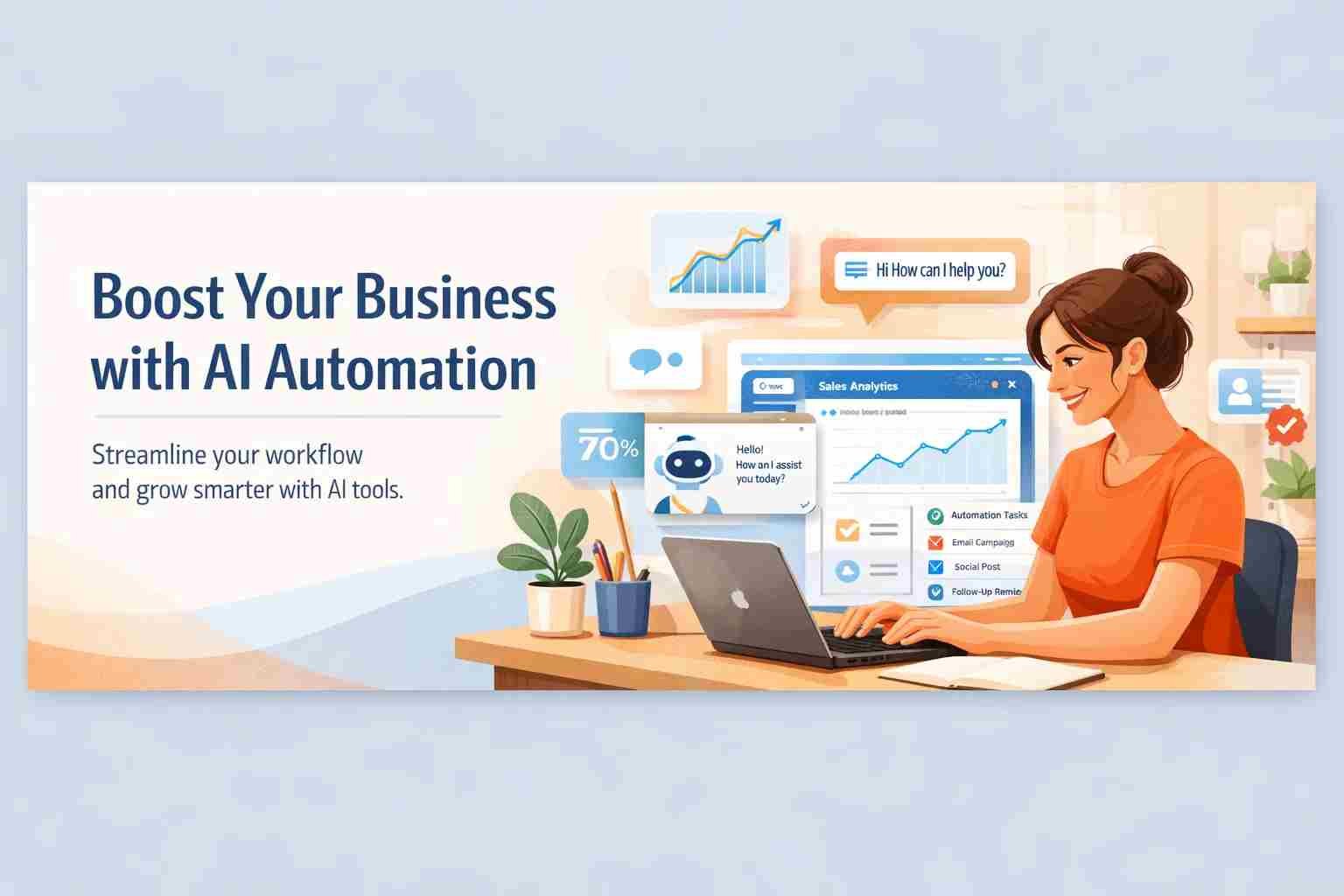
 If you run a small business, here’s the simple truth: a small business AI assistant can save you hours every day. It can reply to customers, write content, organize data, and even help you make better decisions.
You don’t need to be technical. You don’t need a big budget. You just need to understand what AI can actually do and where it fits in your daily work.
Let me walk you through this in a way that actually makes sense.
What is a small business AI assistant in simple words
A small business AI assistant is just a smart tool that helps you do work faster using artificial intelligence.
Think of it like a digital helper.
- It can answer customer messages
- Write emails or posts
- Manage simple data
- Suggest ideas
- Automate boring tasks
For example, if someone messages your business at night, an AI chatbot can reply instantly. If you need product descriptions, AI can generate them in seconds.
Tools like ChatGPT, Notion AI, and Shopify AI are all examples of this.
So instead of hiring extra staff, you’re using software that works 24/7.
Can AI really help a small business or is it hype
Short answer: yes, it helps. But only if you use it the right way.
AI is not magic. It won’t run your business alone. But it can handle repetitive work that normally takes hours.
Here’s where it actually helps:
- Saving time on writing
- Handling basic customer queries
- Automating marketing tasks
- Organizing business data
Where it does not help:
- Deep decision making
- Emotional customer handling
- Complex strategy
The biggest mistake people make is expecting AI to do everything. It works best as a helper, not a replacement.
The real tasks AI can handle for you daily
This is where things get interesting.
A good small business AI assistant can take over many daily tasks:
Customer Support
AI chatbots can answer common questions like prices, timings, and order status.
Content Creation
You can generate blog posts, product descriptions, social media captions, and emails.
Marketing Automation
AI can suggest ad ideas, email campaigns, and SEO keywords.
Data Analysis
Some AI tools can look at your sales data and show trends.
Admin Work
Scheduling, reminders, summaries, and document writing can all be automated.
Here’s the thing most people miss: even saving 1–2 hours daily adds up fast. That’s where real growth happens.
Which AI tools are actually useful for small businesses
There are hundreds of tools out there, but only a few are practical.
Here are the ones that actually make sense:
| Tool | Best Use |
|---|---|
| ChatGPT | Writing, customer replies, ideas |
| Notion AI | Notes, planning, documentation |
| Zapier | Automating workflows |
| HubSpot AI | CRM and marketing |
| Shopify AI | E-commerce automation |
You don’t need all of them. Start with one or two and build from there.
What is the best AI assistant for small business right now
There’s no single “best” AI. It depends on what you need.
- For writing and general help → ChatGPT
- For automation → Zapier
- For sales and CRM → HubSpot AI
- For e-commerce → Shopify AI
If you’re just starting, ChatGPT is usually the easiest entry point. It’s flexible and works for almost everything.
Can ChatGPT replace a CRM or business system
No, and this is important.
ChatGPT is powerful, but it’s not a full business system.
It can:
- Help write emails
- Suggest customer responses
- Generate reports
But it cannot:
- Track customers automatically
- Manage sales pipelines
- Store structured business data
So instead of replacing CRM, it works alongside tools like HubSpot or Zoho.
Think of it as your smart assistant, not your database.
Understanding types of AI without confusing terms
Let’s simplify this.
There are a few basic types of AI:
Narrow AI
This is what we use today. It does specific tasks like writing or answering questions.
Generative AI
This creates content. ChatGPT is part of this type.
General AI
This is still theoretical. It would think like a human.
Type 3 AI
Often described as advanced systems that understand context deeply, but we are not fully there yet.
So when people talk about AI today, they mostly mean narrow or generative AI.
What are the biggest benefits of using AI in business
Here’s what actually matters:
- Saves time
- Reduces costs
- Works 24/7
- Improves consistency
- Helps scale faster
One powerful idea is the “30% rule.”
What is the 30 percent rule in AI and why it matters
The 30% rule means AI doesn’t replace your work. It improves it.
If AI can do 30% of your tasks faster, that’s a huge advantage.
For example:
- Writing content becomes faster
- Customer replies become quicker
- Planning becomes easier
You still do the final work. AI just removes friction.
That’s how small businesses compete with bigger ones.
The risks and mistakes small businesses make with AI
Here’s where people go wrong:
Over-relying on AI
Everything starts sounding robotic.
Using too many tools
You end up confused instead of productive.
Not checking outputs
AI can make mistakes.
Ignoring human touch
Customers still want real connection.
The smart approach is simple: use AI, but stay in control.
Which jobs will survive AI and why
AI will change work, but not everything disappears.
Jobs that survive:
- Creative roles
- Strategy and decision making
- Human communication roles
- Skilled technical work
Why? Because AI lacks real understanding and emotions.
So instead of fearing AI, the better move is learning how to use it.
Which AI tools are people comparing with ChatGPT
Right now, people are comparing:
- Google Gemini
- Claude AI
- Grok by Elon Musk
- Microsoft Copilot
Each one has strengths, but ChatGPT remains the most flexible for everyday use.
What I would do if I started a small business today using AI
I’d keep it simple.
First, I’d use ChatGPT for writing and customer replies.
Then I’d add Zapier for automation.
After that, a CRM like HubSpot for managing customers.
That’s it.
No complicated setup. No overload.
Just tools that actually save time.
Where AI is going next for small businesses
AI is becoming more integrated.
Soon, you won’t even think about “using AI.”
It will just be part of your apps, your website, your tools.
Smarter automation, better personalization, and faster workflows.
The businesses that adapt early will move faster.
The ones that ignore it will feel slow.
And honestly, once you start using a small business AI assistant properly, it’s hard to go back to doing everything manually.

Alexandra Smith: All things tech, News, Social Media Guide, and gaming expert. Bringing you the latest insights and updates on Mobiledady.com