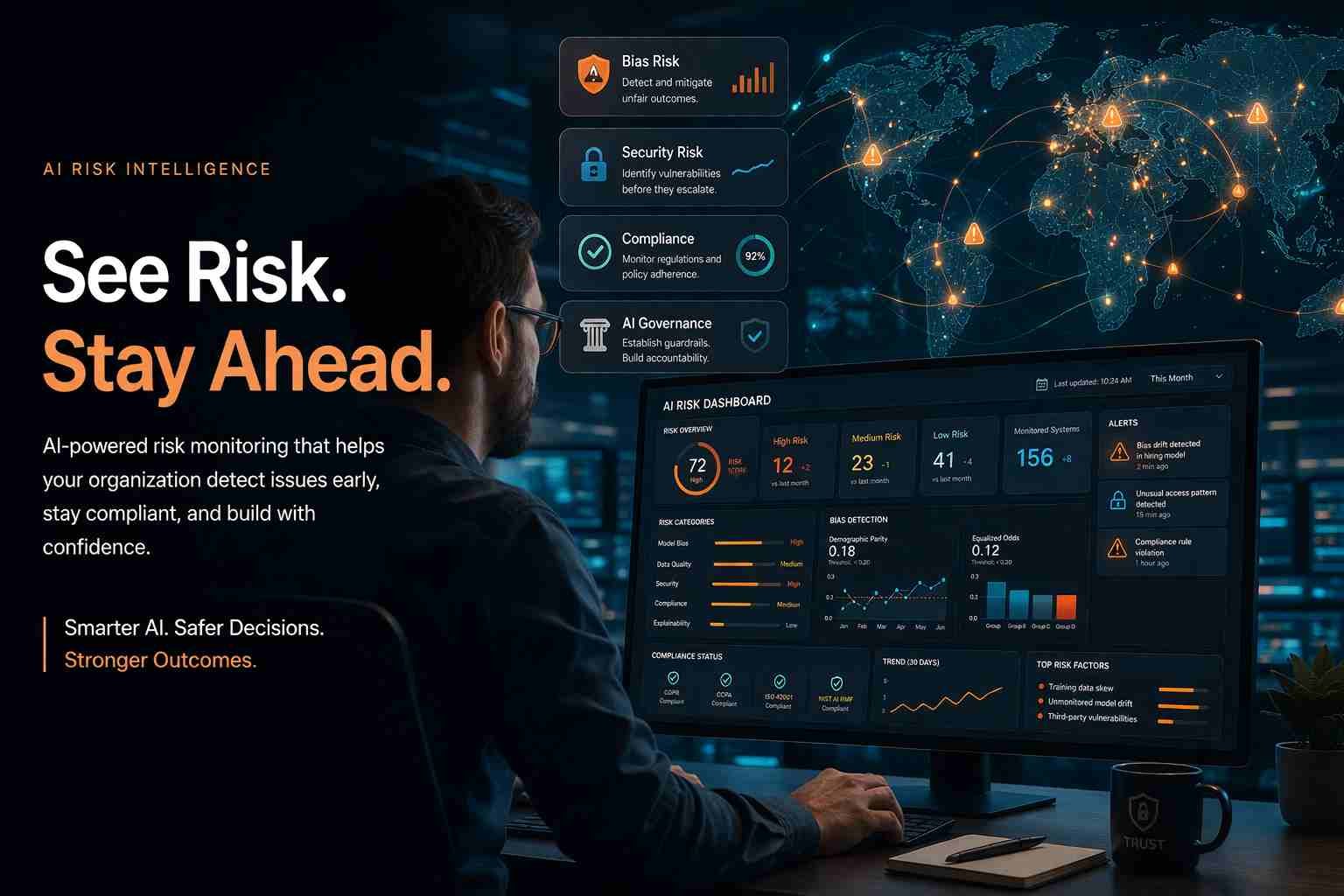
 If you’ve heard about the IBM AI Risk Atlas and felt confused, you’re not alone.
Here’s the simple truth: it’s basically a structured way to understand, track, and manage risks that come with AI systems.
Instead of guessing what could go wrong with AI, IBM created a kind of “map” that shows different types of risks, where they appear, and how to handle them. That’s why they call it an atlas.
Let me break it down in a way that actually makes sense.
What is IBM AI Risk Atlas in simple words
The IBM AI Risk Atlas is a framework that helps people understand and manage risks in artificial intelligence.
Think of it like Google Maps, but instead of roads and cities, it shows different kinds of AI problems. Things like bias, security issues, wrong predictions, or misuse.
IBM designed it to help companies answer one big question:
“Where can AI go wrong, and how do we fix it before it causes damage?”
Instead of treating AI risk as one big scary thing, the atlas breaks it into smaller parts so teams can actually deal with it.
Why IBM created something like an AI risk atlas
AI is growing fast. Faster than most people can fully understand.
And here’s the problem:
When AI makes mistakes, the impact can be serious.
- A hiring AI might reject good candidates unfairly
- A medical AI might give wrong recommendations
- A chatbot might generate harmful or misleading content
IBM saw that companies were using AI without clear risk awareness.
So instead of waiting for problems, they created a structured system to predict, categorize, and manage risks early.
It’s less about fear and more about control.
The idea behind mapping AI risks like an atlas
Here’s where the concept gets interesting.
An atlas organizes information in a way that’s easy to explore.
IBM applied the same idea to AI risks.
Instead of random issues, risks are grouped and mapped based on:
- Where they appear in the AI lifecycle
- What kind of damage they can cause
- Who is affected
- How serious they are
This makes it easier for teams to:
- Spot risks early
- Understand relationships between risks
- Prioritize what needs attention first
It turns something abstract into something visual and manageable.
The four types of AI risk you should understand
Most AI risks fall into a few major categories. IBM’s approach aligns closely with these.
Bias and fairness risk
This happens when AI treats people unfairly.
For example:
A loan approval system might favor one group over another because of biased training data.
This is one of the biggest issues in AI today.
Security and misuse risk
AI can be used the wrong way.
Think about:
- Deepfakes
- AI-generated scams
- Automated hacking tools
Even a good system can become dangerous if used incorrectly.
Privacy risk
AI often uses personal data.
If not handled properly, it can expose sensitive information.
For example:
An AI system trained on user data might accidentally reveal private details.
Reliability and performance risk
Sometimes AI just gets things wrong.
- Wrong predictions
- Hallucinated answers
- Inconsistent results
This is especially risky in areas like healthcare or finance.
How IBM handles AI risk management in real systems
IBM doesn’t just talk about risks. They build systems to manage them.
Their approach includes:
- Monitoring AI models during use
- Checking for bias and fairness
- Tracking performance over time
- Applying governance rules
They focus on something called AI governance, which means controlling how AI is built, used, and monitored.
Instead of “set it and forget it,” IBM treats AI like something that needs constant supervision.
What AI tools IBM uses for risk and governance
IBM uses a mix of platforms and tools to manage AI risks.
IBM Watson
This is IBM’s well-known AI system.
It’s used in healthcare, business analytics, and automation.
AI governance platforms
These tools track how AI models behave.
They help answer questions like:
- Is this model fair?
- Is it still accurate?
- Is it safe to use?
Risk monitoring systems
These systems watch AI in real time.
If something goes wrong, they can alert teams immediately.
Where this matters in real life
This isn’t just theory. It affects real people.
Healthcare
Wrong AI decisions can affect patient treatment.
Finance
Bias in AI can lead to unfair loan approvals.
Hiring systems
AI might filter out candidates unfairly.
Social media
AI can spread misinformation or harmful content.
That’s why risk management isn’t optional anymore.
The part most people misunderstand about AI risk
A lot of people think AI risk means AI is dangerous by default.
That’s not really the point.
The real issue is lack of control and awareness.
AI becomes risky when:
- It’s not monitored
- It’s trained on poor data
- It’s used without guidelines
The IBM AI Risk Atlas isn’t about fear.
It’s about understanding and managing reality.
How businesses and developers can use this concept
You don’t need to be IBM to use this thinking.
Even small teams can:
- Think about where their AI might fail
- Check for bias early
- Monitor outputs regularly
- Keep humans involved in decisions
It’s more of a mindset than a tool.
Once you start thinking in terms of risk, your systems become more reliable.
So what does this mean for the future of AI
AI is not slowing down.
But trust is becoming just as important as innovation.
Frameworks like the IBM AI Risk Atlas show where things are heading:
- More transparency
- More regulation
- More accountability
Companies that understand risk will move faster in the long run because people will trust their systems.
And honestly, that’s what AI needs right now.

Alexandra Smith: All things tech, News, Social Media Guide, and gaming expert. Bringing you the latest insights and updates on Mobiledady.com